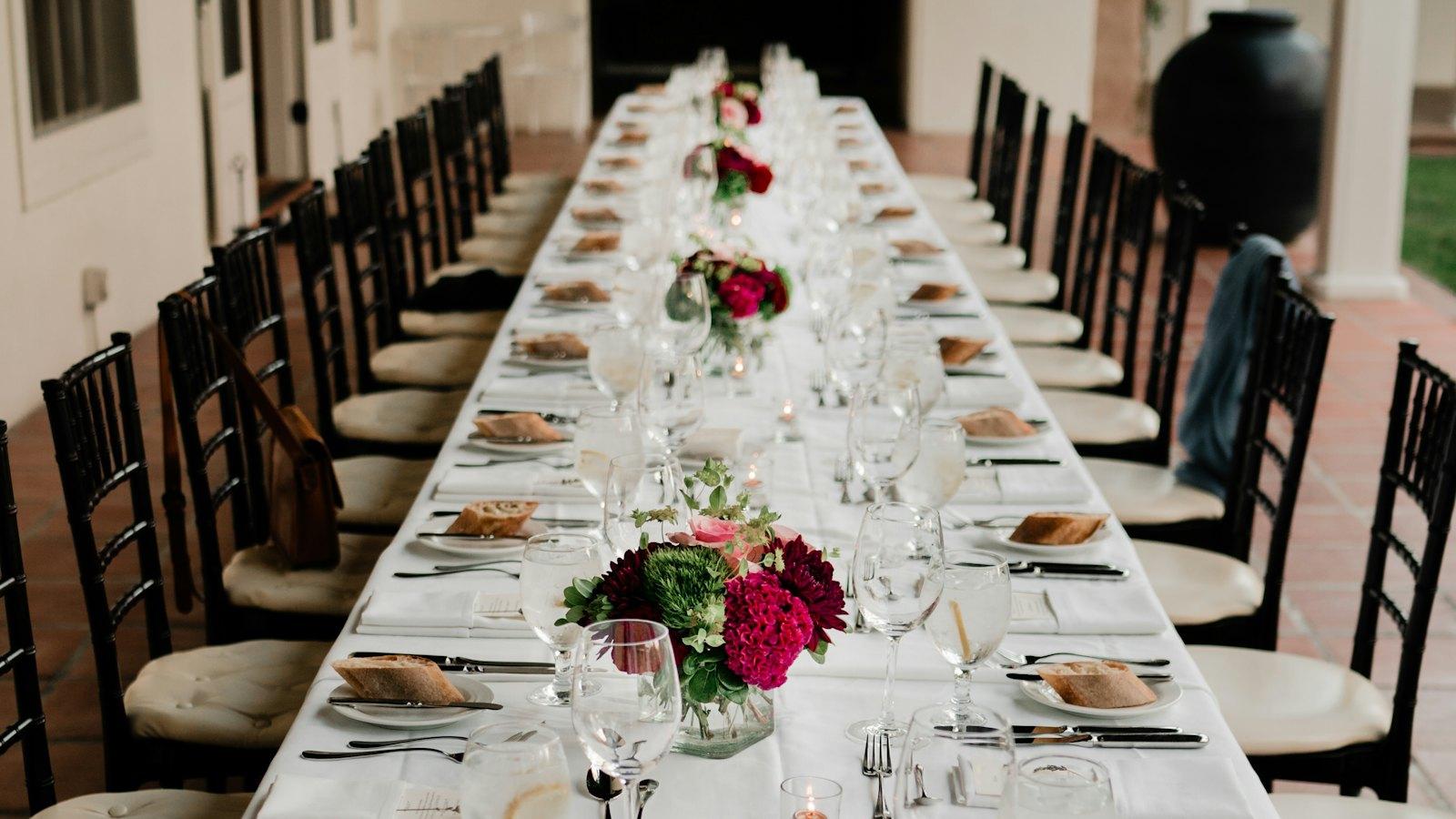
Past a certain size a group stops being a table and becomes the evening. At that point it is simpler for everybody to take the place entirely — and usually cheaper than most people assume.
What applies to larger parties generally is in our guide to them.
Simpler for both sides
A group with the room to itself has nobody to consider, and a house does not have to run two different evenings at the same time.
When it makes sense
The rule of thumb: once a group takes more than half the seats. With thirty covers that is around twenty people.
The reason is not the bill but the atmosphere. A celebration of twenty is loud, and the remaining ten guests spend the evening inside somebody else's party. Both sides have a worse evening than they could have had.
For the house there is also the fact that a half-occupied room with a loud group is hard to serve: the group orders in waves, the individual tables in between, and service is pulled both ways.
What exclusive actually means
That no other guest comes in — including anyone who only wants a glass of wine. For a place on a busy street that means locking the door and putting up a notice, and for regulars it means finding it closed that evening.
Which is why good houses announce it in advance, and why an exclusive booking on a Saturday costs more than one on a Tuesday.
Minimum spend rather than hire
The usual arrangement in Vienna, and the fairer one. Instead of a room charge, a minimum spend is agreed: a sum that has to be reached that evening. Anything above it is billed normally; anything below is topped up.
The advantage for the person booking is that they get something for their money — food and drink — rather than paying for an empty room. The advantage for the house is that a normal evening is covered.
How high the sum sits depends on the day. A Tuesday in February is a fraction of a Saturday in December, and flexibility saves a great deal — particularly for office parties, as the office party describes.
What to settle beforehand
The food. With an exclusive booking, a reduced menu or a set menu is practically always the route, because thirty people cannot be served à la carte simultaneously — a menu for groups describes how that looks.
The drinks. All included, a budget, or individually — settled in advance, or it gets discussed at the end of the evening. Drinks for a crowd goes through the options.
The times. When it opens, when the food comes, when it ends. With an exclusive booking the end matters as much as the start, because it is tied to closing hours and to the neighbours.
What may be brought. A cake, generally yes; your own drinks, generally no. Music, decoration and equipment belong in the conversation rather than being assumed.
The enquiry itself
What a house needs in order to answer at all: the date, an approximate head count, the hours and the occasion. Four items, and an enquiry without them only produces a question back.
It also helps to name a rough budget. That feels awkward and saves both sides a great deal of time, because a house can then say immediately whether the evening is possible in that form.
A deposit is usual
With an exclusive booking a deposit is normal, because the house turns away every other guest for that evening. Twenty to thirty per cent of the agreed minimum spend is usual, and it comes off the final bill.
A cancellation deadline goes with it, and it is considerably longer than for an ordinary table — for a single table, cancelling the day before is enough, as when to book a table in Vienna describes.
What a small house cannot do
Honesty belongs here: a bistro with thirty covers is not an event space. There is no stage, no dance floor and usually no separate cloakroom, and the kitchen is built to cook for thirty people at once, not eighty.
Anyone needing more is better served by a larger house, and saying so is part of answering an enquiry properly.
Book a table — and for anything larger, please call.