An office party is the one group booking where the person making it usually neither pays nor decides what gets eaten. Almost everything that runs differently about it follows from that.
What applies to larger parties generally is in our guide to them.
It is rarely a party
The most important difference: for most of the people present it is work, even though it happens in the evening. That changes the pace, the volume, and the question of when somebody may leave.
December goes early
In Vienna, Christmas parties fall between late November and the week before Christmas, and in small houses the Fridays and Saturdays in that stretch are often gone by October.
Flexibility helps enormously: Tuesdays and Wednesdays are bookable even in December, and a party in mid-January is welcome anywhere, because the weeks after New Year are the quietest of the year.
Somebody has to decide
The commonest failure is a booking where nobody was given authority to choose the food, and twenty people decide by email instead.
What to settle beforehand
Who pays and how. A company usually pays on invoice, and that needs a billing address, sometimes a purchase order number, and clarity on whether drinks are included.
Whether drinks are included. This is the commonest point of dispute at the end of the evening. Three arrangements are usual: everything included, a budget per head, or food on the company account and drinks individually. All three work if they are agreed in advance — more on that in drinks for a crowd.
The final head count, by an agreed day. With office parties the gap between sign-ups and attendance is larger than with private groups, and a house costs its evening on that number.
The food. A reduced menu is nearly always the better route, because otherwise the kitchen has to finish twenty different dishes simultaneously — described in a menu for groups.
The sequence that usually works
Arrive at six with a drink standing, sit at half past, eat at seven. It sounds rigid and it solves the main problem: people do not leave the office simultaneously, and a dinner starting at six waits for half the guests.
The half hour in between is therefore not a delay but the buffer that saves the evening. What gets poured during it decides more than people expect — drinks for a crowd goes into it.
The seating
At an office party this matters, and it is worth deciding rather than leaving to chance. Without a plan people sit with whoever they work with daily, and the party becomes a continuation of the office.
In practice: name cards, or a brief word as people sit down. Either takes five minutes and changes the evening noticeably.
What separates it from a private celebration
It starts earlier and ends later. Six in the evening is a common start, because people come straight from the office, which means the first hour is more a standing reception than a dinner.
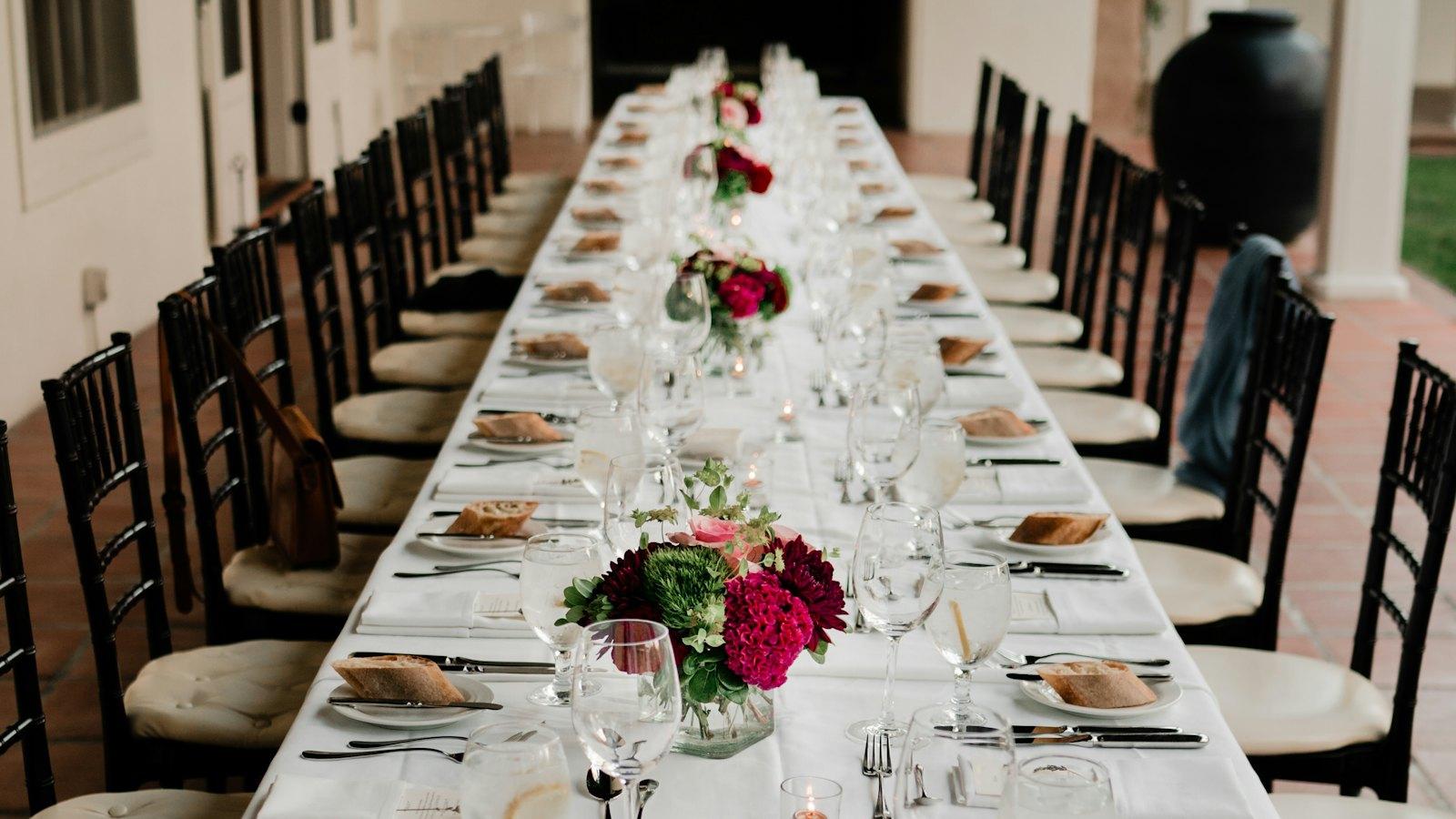
The mix is broader. People are sitting beside colleagues they did not choose to sit beside, and that changes which table shape works — more on that in planning a large table.
And more gets drunk than eaten, at least towards the end. A house set up for it keeps the bar open rather than the kitchen.
Whoever organises it needs answers
The person booking has to answer questions internally that they do not decide themselves: what does it cost per head, is there something vegetarian, how long does it run, can people get there by underground.
A house that answers all of that in one email rather than four makes their job easier — and gets the booking. It is why enquiries for office parties get fuller answers than others.
What needs settling overlaps heavily with what applies to any larger party — planning a large table runs through it.
When the whole place makes sense
Roughly at the point where the group takes more than half the seats. It disrupts the rest of the service anyway by then, and both sides do better with a clear arrangement — hiring the whole place describes how that runs.
Book a table — for December, better in October.