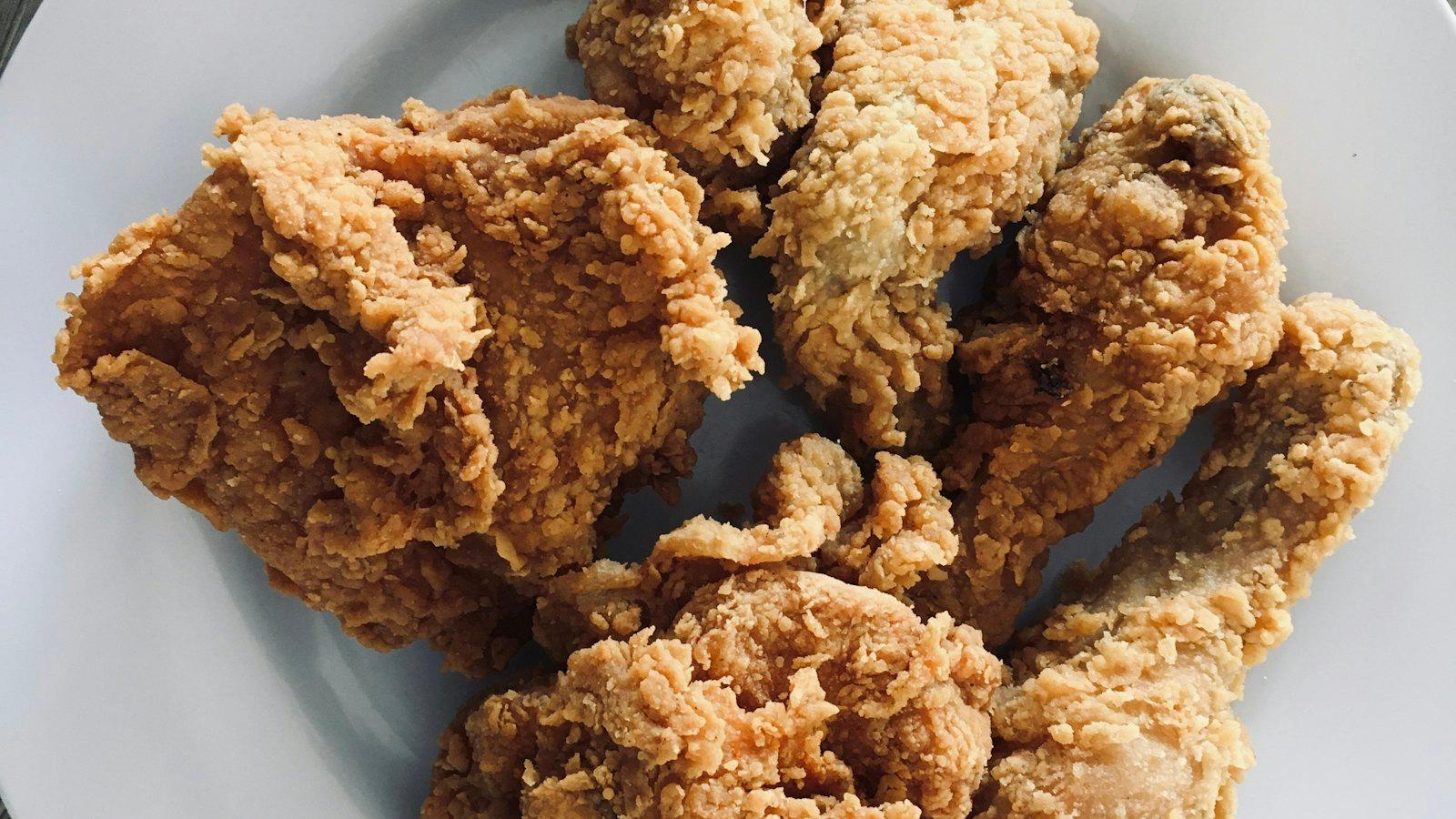
In the shadow of the schnitzel stands a second crumbed dish, older than it, and for a long time considered the finer of the two in Vienna. In the eighteenth century a Backhendl was a luxury: chickens cost more than veal.
Why Viennese cooking built two classics on the same technique is one of the questions in what makes a classic a classic.
The same method, a different problem
Flour, egg, breadcrumbs. The coating is identical to a schnitzel's and the rules are unchanged — lay it on loosely, do not press, fry immediately. All of that is set out in what actually matters in a Wiener Schnitzel.
The difference is geometry. A schnitzel is four millimetres thick and the same everywhere. A chicken is a three-dimensional animal with bones, with parts that are cooked in eight minutes and parts that need twenty.
That sets the problem. The coating is finished after a few minutes and then starts to darken. The meat near the bone is still raw at that point. Wanting both at once means dropping the temperature below what a schnitzel needs — and that risks exactly what a coating cannot survive: fat that is not hot enough.
How it gets solved
There are two honest approaches, and both work by avoiding the problem rather than solving it.
The first is to joint the bird and treat the pieces separately. Leg and breast have different cooking times, so they go into the fat one after the other. It is more work and it gives the better result.
The second is to part-cook the larger pieces gently — in the oven or in stock — and only then crumb and fry them. The coating spends three minutes in the fat, which is exactly as long as it needs.
What does not work is lowering a whole bird into medium-hot fat and hoping. That produces a dark, leathery shell and patches inside that nobody wants to eat.
Why it dries out faster than a schnitzel
Chicken breast has little fat and little connective tissue. It does not forgive two minutes too many, where a piece of veal shrugs them off. This is the real reason most disappointing Backhendl disappoint: not the coating, the meat underneath it.
The leg is the more forgiving cut by some distance. More fat, more connective tissue, and a far wider window in which it is good. Given the choice, take the leg.
What belongs beside it
Traditionally: potato salad, or a green salad with pumpkin seed oil, and lemon. Always lemon. The logic is the schnitzel's — acidity against fat, so the last mouthful is as good as the first. Which sides belong with which classic is in dumplings, potato salad and the rest of the plate.
What does not belong is a sauce. A Backhendl under sauce is a contradiction: you have spent an hour building a crisp shell and then softened it.
Where the name comes from
In Austria, backen means what elsewhere is called deep frying. So a Backhendl is simply a fried chicken, and the same root turns up in Backerbsen, Backfisch and the verb herausbacken.
That is more than etymology, because it sets the expectation. Backen means swimming in plenty of fat, not browned in a shallow pan. A chicken cooked in a little fat in a flat pan is a different dish with a different result: patchy on the outside, and dry wherever it made contact with the metal.
A word about the fat
Plenty of it, hot, and moving — exactly as for a schnitzel. And as with a schnitzel, fat that has been in use too long ruins any coating. You can spot old fat by how fast the crumb goes very dark while still being soft underneath.
Clarified butter would be the classic choice but is barely practical in the quantity required. A neutral oil with a high smoke point does the job, as long as it is clean. And the bird goes into the fat dry: moisture on the coating makes the fat spit and cools it exactly where it needs to stay hot.
Book a table — coatings are better argued about at a table than in writing.