A Wiener Schnitzel is four things, and each of them can ruin it. That is the whole reason it is treated as a test.
It is also the Austrian end of a menu whose other half runs further south — the subject of our guide to Austrian and Mediterranean cooking.
First: veal
Wiener Schnitzel means veal. Anything else is a schnitzel "in the Viennese style" and may call itself that, but not the other. This is not pedantry, it is a question of taste: veal is milder and finer, which is exactly why it can carry the coating without being buried by it.
The cut matters just as much. Classically it comes from the topside or the cushion — from the leg — because those muscles are evenly grained and take a beating without falling apart. A piece with sinew running through it warps in the pan and curls at the edges.
Second: thin, but not beaten to pieces
The meat is flattened until it is an even four millimetres or so. Even matters more than thin. Wherever the schnitzel is thinner, it dries out before the rest is done.
Flatten it by pushing outwards, not by hammering down. Work with force and you tear the fibres, and a torn schnitzel loses juice in the pan that it never gets back. Salt it shortly before, not long before: salt draws water, and water is the enemy of the coating.
Third: the coating
Flour, egg, breadcrumbs, and nothing pressed down between the steps. The coating should sit against the meat, not stick to it. Press it on and you get a crust; leave it loose and you get the thing that makes a Wiener Schnitzel.
The crumbs want to be dry and fairly coarse, ideally from stale white bread. Fine shop-bought breadcrumbs make a dense, sandy layer that can never lift away from the meat. And the egg is beaten, not extended: milk or cream in it softens the coating.
Crumbing cannot be done in advance. A schnitzel that has sat breaded for twenty minutes has a coating that has already gone damp, and no amount of hot fat will make it light again.
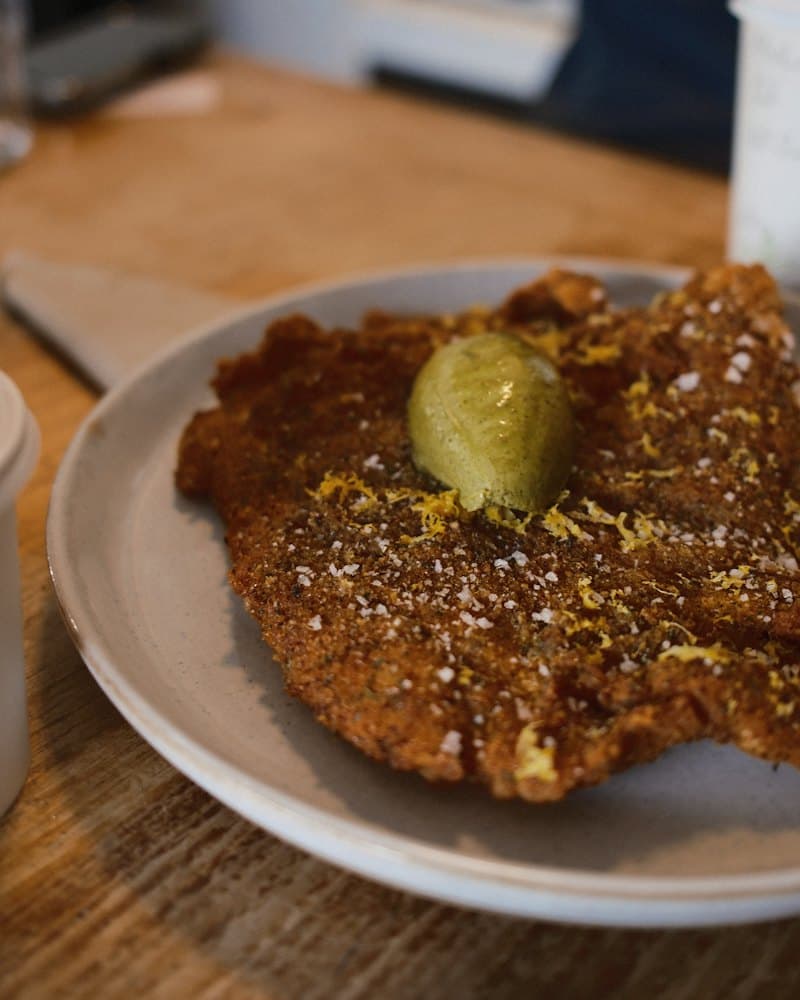
The puff is the tell. A good Wiener Schnitzel has blisters between the meat and the coating, and that is neither an accident nor decoration: it happens only when there is enough hot fat in motion and the coating sits loose. It is how you recognise one that had room in the pan.
Fourth: fat, and movement
Plenty of fat, hot, and the pan kept moving so the schnitzel swims. Too little fat means frying rather than deep frying, and then the coating stays flat and soaks itself. This is precisely where Austrian food gets its reputation for being heavy — even though heavy is not the same as filling.
How to spot a bad one
You do not need to be a cook to judge a schnitzel. Three things are visible before you taste it.
The colour: a good one is golden to light brown and uneven. A uniformly dark brown, smooth surface comes from old fat; a pale one from fat that was not hot enough.
The plate underneath: if fat pools on it, or the paper turns translucent, the coating absorbed what it should have kept out.
And the sound. A coating that has puffed is audible under the knife, and it comes away in sheets rather than crumbs. One that clings to the meat was either pressed on or left sitting breaded for too long.
Alongside: nothing complicated
Lemon. Lingonberries, if you like them. And a salad with some acidity, because the schnitzel brings none of its own. Potato salad belongs with it when it is lukewarm and made with vinegar rather than mayonnaise — the difference is the same one the lemon makes: acidity keeps the dish awake down to the last mouthful. That is exactly how it appears on our menu, and it is fried when it is ordered, not before.
It also belongs on your own plate rather than in the middle: the coating does not survive being passed around, which is why sharing, or not puts it on the short list of dishes to keep to yourself.
Book a table while the fat is hot.