Asparagus is the only vegetable in Austria with a known end date. The harvest traditionally stops on 24 June, and after that there is none until the following spring — none from here, at any rate.
How a kitchen year organises itself around deadlines like that is the subject of our guide to cooking with the season. This piece is about the asparagus itself.
The deadline is arithmetic, not tradition
The date looks arbitrary and is not. Asparagus is a perennial: what gets harvested is the young shoot, and what does not get harvested grows into a fern the height of a person. That fern is the entire point — over the summer it builds the reserves the plant lives on when it pushes up the following spring.
Harvest past June and you take that recovery away. The plant comes up weaker the next year, the spears get thinner, and after a few seasons the field is spent. An asparagus bed runs fifteen to twenty years if it is left alone, and considerably fewer if it is not.
White and green are the same plant
A common misunderstanding: these are not two varieties. White asparagus is asparagus grown under a ridge of soil that never saw daylight. Green is the same shoot grown above ground, which has made chlorophyll.
The difference in flavour follows from that. White is milder, faintly bitter, and more delicate, because it has done no photosynthesis. Green is stronger and nuttier, and it is less work: usually it is not peeled at all, or only in the bottom third.
The labour also explains the price. White asparagus has to be cut before the tip breaks through the ridge — meaning every spear is lifted out of the soil by hand, often twice a day. No machine does that.
How to spot a fresh spear
Three tests, none of which needs a kitchen.
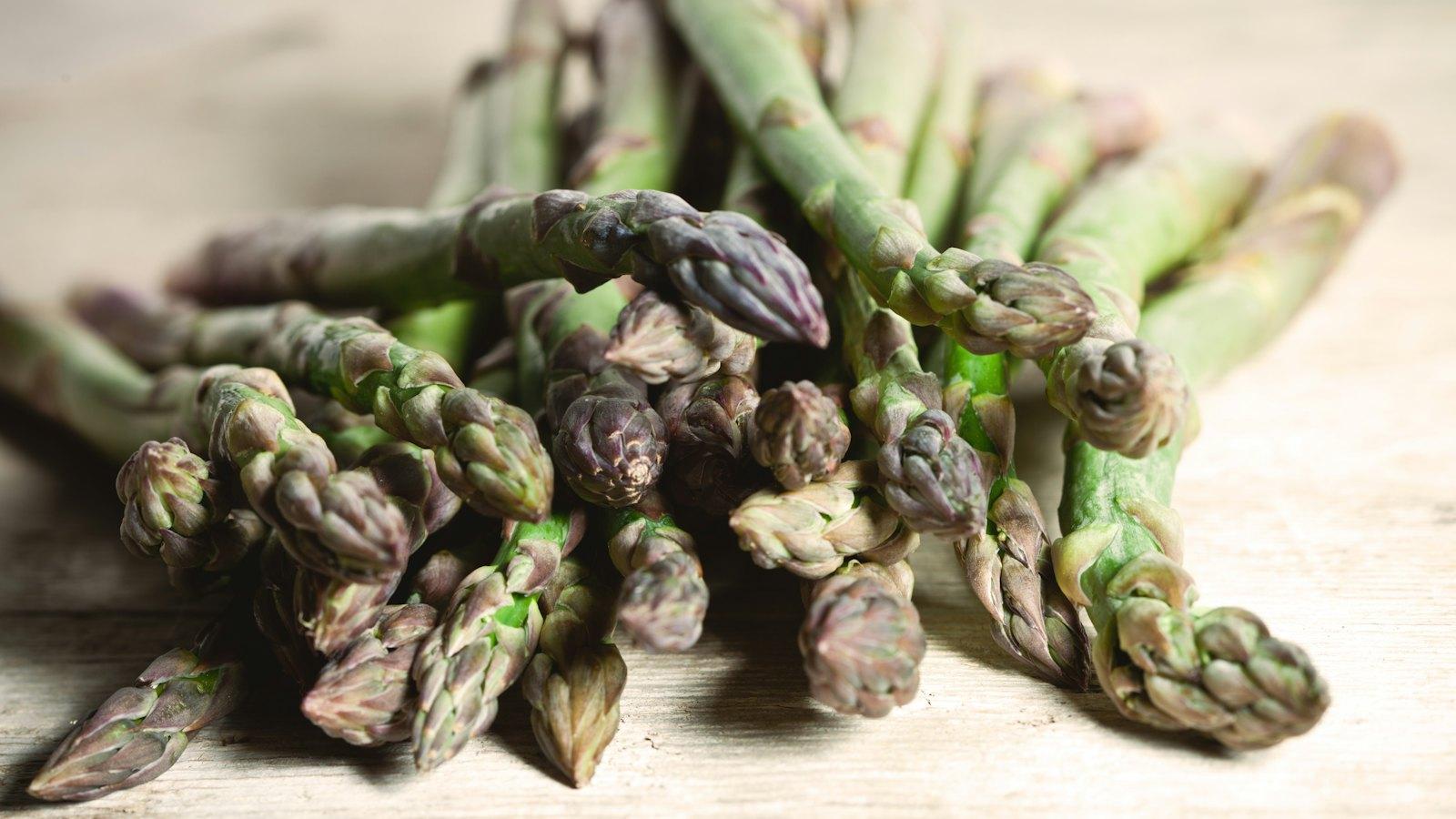
The cut end is moist and pale. Once it turns dry, woody or brownish, the spear has been sitting for days. Fresh asparagus squeaks when two spears are rubbed together — an audible, almost unpleasant sound that older stock no longer makes.
And a fresh spear snaps rather than bends. If it curves like rubber, it has lost water.
It keeps for a day or two wrapped in a damp cloth in the fridge, and no longer. That is the same arithmetic as any short-lived produce — it applies just as much to herbs.
In the kitchen: do very little
Asparagus is easy to ruin, and almost always by doing too much. Cooked too long it turns watery and collapses; buried under accompaniments it loses exactly the thing you paid for.
White asparagus is poached in lightly salted water with a pinch of sugar, ten to fifteen minutes depending on thickness, and is done when a knife goes through without resistance. Green needs four to six minutes, or belongs in a pan.
What goes with it is fat and acidity: melted butter and lemon, or olive oil and parmesan. That is the same principle every side in our kitchen works on — set out in dumplings, potato salad and the rest of the plate.
Thick or thin
Thick spears are not the inferior grade but frequently the better one. The diameter depends on the age of the plant: young beds give thin spears, established ones thick. Thick asparagus has more flesh relative to its skin and is therefore more tender, not woodier.
More important than thickness is that every spear in a bunch is the same thickness. Otherwise half of them collapse while the other half are still raw.
What to do with the peelings
Throwing them away is the standard mistake. Peelings and woody ends simmered with water, butter and an onion give you a stock in twenty minutes that tastes better than the cooking water, and that stock is the base for a soup or a risotto. Having paid for the asparagus, you have already paid for them, and it costs twenty minutes of simmering and no attention at all.
Book a table — in spring it is on the board, and for the rest of the year, honestly, it is not.