The question "fresh or dried" is usually posed wrongly. Dried is not the inferior version of fresh; it is a different ingredient — distinctly better for some herbs and completely worthless for others.
The part herbs play across the year is in our guide to cooking with the season. This piece is about the distinction that actually matters in a kitchen.
The dividing line is the oil
Herbs carry their aroma in essential oils, and those oils differ in how readily they evaporate. That is the whole explanation.
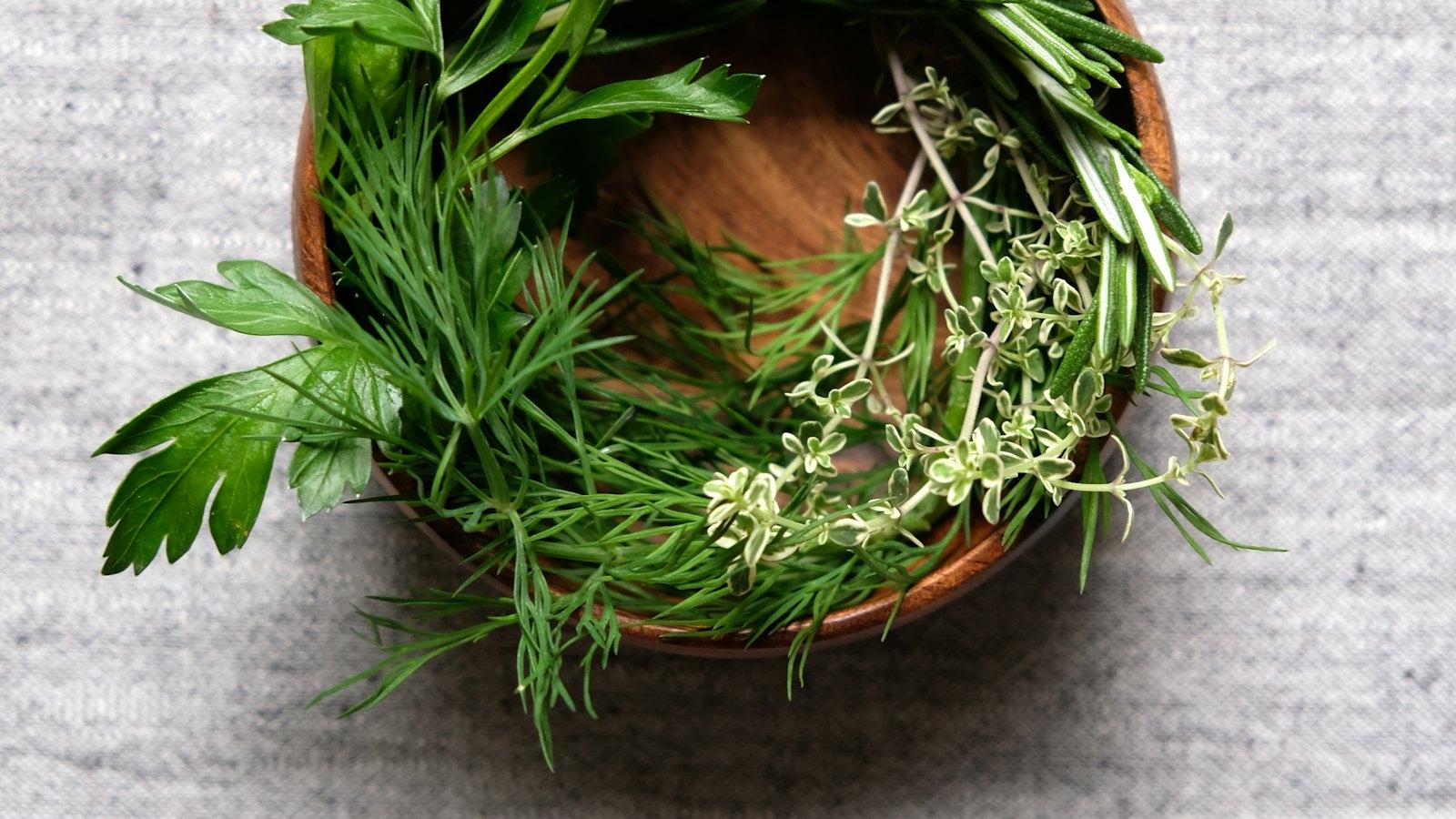
Soft herbs — parsley, chives, basil, dill, coriander — have light oils that go quickly. Drying removes most of them, and what remains tastes of hay. Dried basil is not a substitute for fresh basil; it is a different thing, best left out.
Hard herbs — rosemary, thyme, oregano, marjoram, bay, sage — carry heavier oils in tougher leaves. Drying concentrates them rather than destroying them. Dried oregano is stronger than fresh, and marjoram is one of the few cases where dried is the normal choice — covered in paprika, caraway, marjoram.
Which decides the timing
Hard herbs go in early and take hours. Rosemary and thyme belong in a braise from the start, and so does bay.
Soft herbs go in last — in the final seconds, or onto the plate. Parsley that has boiled for twenty minutes is grey sludge with no flavour.
The exception is the stalks. Parsley stalks are firmer than the leaves, stand up to heat, and give more flavour than you would expect. They belong in the stock while the leaves belong on the finished plate. Very little of a herb is ever thrown away — the same thinking as in two kitchens, one shopping list.
What an Austrian kitchen keeps
The list is short and audibly different from an Italian one.
Parsley is the workhorse, and it is the flat-leaf kind. It goes into soups, onto potatoes, into stocks and onto almost every savoury plate. Chives are second, and in Vienna they are not a garnish but an ingredient: chive sauce with Tafelspitz, chives on bread, chives in scrambled eggs.
Then lovage, which Austrians call Maggikraut and which tastes exactly like that — use it very sparingly. And marjoram, bay and thyme for anything braised.
What a Mediterranean kitchen adds is basil, oregano and rosemary, and this is one of the few points where our two halves genuinely need different ingredients.
Cut, do not chop
Soft herbs are sliced rather than hacked, and the difference is visible. A blunt knife crushes the cells, the juice runs out, and what stays on the board is a dark green smear — precisely the essential oils that should have ended up on the plate.
A sharp knife and few strokes solve it. Basil is often torn rather than cut for the same reason: it is especially sensitive and blackens quickly along a cut edge.
The same applies to timing. Herbs are cut when they are needed, not twenty minutes beforehand. Chopped parsley left sitting on a board loses exactly what it was chopped for.
Fresh herbs do not keep
Soft herbs last three to five days if stored properly: stood in water like a bunch of flowers, loosely covered with a bag, in the fridge. Basil is the exception and wants room temperature, because it blackens when chilled.
Hard herbs keep a fortnight wrapped in a damp cloth. And whatever is left over goes into oil, vinegar or butter — a herb butter is the simplest way to rescue a bunch of parsley that would otherwise be finished by Thursday.
Freezing works better than its reputation, though not for salads. Finely cut herbs frozen in ice cube trays with a little oil or water keep their aroma for months and go straight from frozen into a soup, a sauce or a braise. What they lose is texture — they are no longer any use for scattering over a finished plate, and entirely fine cooked into something.
Only the hard herbs get dried, and even those fade noticeably after about a year. Dried thyme that has stood in a jar for three years is decoration.
Book a table — the kitchen smells different in summer than it does in February.