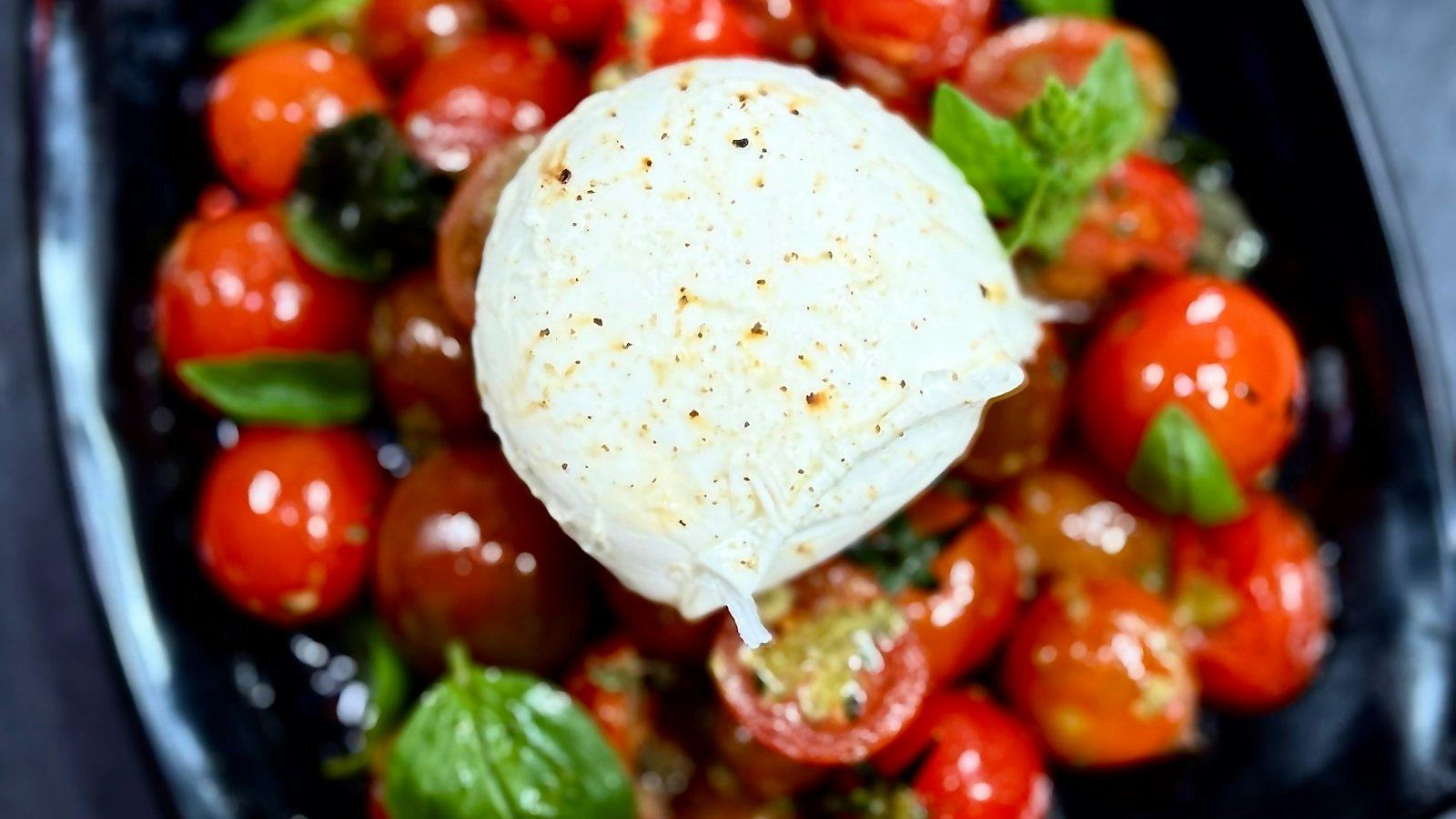
A burrata looks like a mozzarella and is something else entirely inside. The difference is not the variety but what gets done with the same curd.
Why this half of our menu hangs on a handful of products is in our guide to the Mediterranean side.
Three cheeses from one curd
All three start identically: the curd is kneaded and stretched in hot water until it turns stringy and elastic. The process is called filatura, and it turns curd into a pasta filata cheese.
Mozzarella is that curd, shaped into a ball, finished. Firm, milky, faintly sour.
Stracciatella is the same curd torn into strands and mixed with cream. Soft, loose, considerably richer. The name means "torn", which is exactly what it is.
Burrata is a shell of mozzarella filled with stracciatella. Firm outside, liquid inside — the whole point arrives when you cut it open. It was invented in Puglia as a way of using offcuts: the trimmings from mozzarella production became the filling.
Cow or buffalo
The second difference that counts. Buffalo milk has nearly twice the fat of cow's milk and more protein, and the cheese from it is whiter, sharper and considerably more aromatic. Cow's milk mozzarella — fior di latte in Italy — is milder and firmer.
Burrata is usually made with cow's milk, because the shell has to hold. For a caprese or a pizza, buffalo mozzarella is the clearly better choice, and the difference is immediate.
The water belongs to it
Fresh cheese of this kind is sold in its own whey or in brine, and that liquid is not packaging. It keeps the cheese moist and stops the surface drying into something rubbery.
So: do not drain it and leave it sitting. A mozzarella that has been dry on a plate for an hour is a different cheese, and a firmer, duller one than the cheese that went onto it.
Cold is wrong
The commonest serving mistake. Straight from the fridge, fresh cheese tastes of almost nothing — fat carries aroma, and cold fat does not release it. Twenty to thirty minutes at room temperature turn the same piece into something else.
Then very little goes with it: good olive oil, coarse salt, perhaps basil or pepper. Because the cheese is mild, the oil has to be assertive — what that depends on is in how to recognise good olive oil.
They are not for cooking
Both belong on the plate rather than in a pan. Fresh cheese of this kind is very high in water, and heat drives that water out: the cheese tightens, the liquid pools, and what is left is rubbery.
On a pizza, buffalo mozzarella therefore only works if it is drained first and added late. For anything with a long time in the oven you use the firmer, drier pizza mozzarella — a different product despite the shared name.
A burrata goes nowhere near heat under any circumstances. Its filling is an emulsion of cream and cheese strands, and heat splits it immediately.
What to put it with
Acidity and sweetness, ideally both. Ripe tomatoes supply both at once, which is why the combination is so old — provided the tomatoes are worth eating, which tomatoes that taste of something addresses.
Outside tomato season, grilled vegetables, figs, courgette or roasted peppers work just as well. What does not work is pale winter tomatoes; better to put something else underneath than to insist on the classic combination out of season.
A shelf life in hours
A burrata should be eaten on the day it is opened, and within two or three days of being made. It does not spoil, but it firms up and loses precisely the softness you bought it for.
That makes it an ingredient a kitchen cannot stockpile — the same arithmetic as everything short-lived. A menu carrying burrata all year round is necessarily ordering it in quantities that cannot be used within two days, and then it sits. How you notice: it can be cut without running. A burrata that holds its shape under a knife has already lost the argument, whatever it says on the label about the day it was made.
Book a table, ideally before it goes cold.