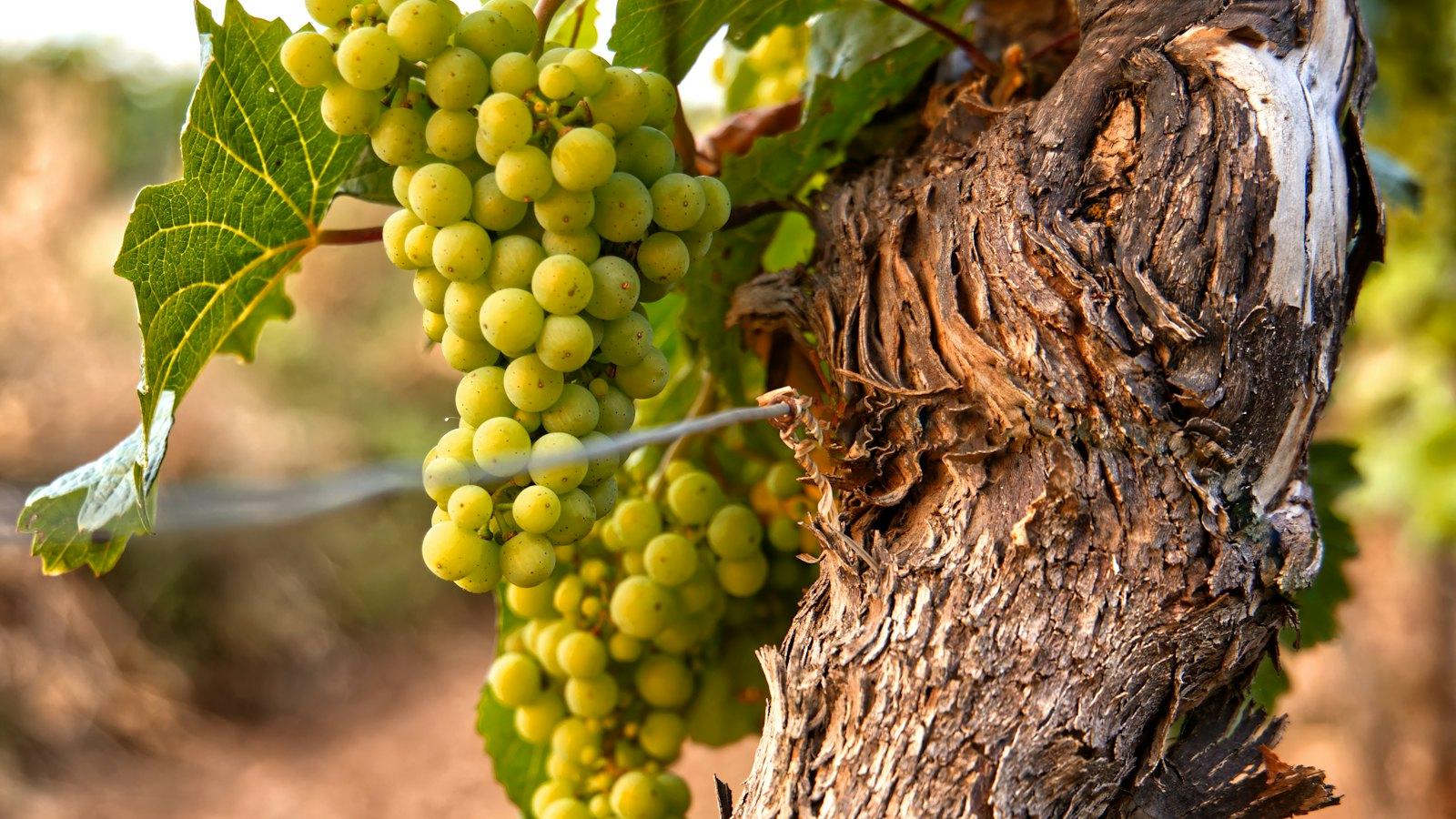
Grüner Veltliner occupies roughly a third of Austria's vineyard area, which makes it the grape the country is recognised by abroad. The remarkable part is not the quantity but the range: from a light tavern wine to a white that ages for a decade, it is all the same grape.
Why Austrian wines suit our menu at all is the question in our guide to them.
The pepper is not imagined
The characteristic note is called Pfefferl in Austria, and it is chemically the same compound as in white pepper: rotundone. People perceive it to very different degrees — a proportion of the population barely smells it at all — which is why descriptions diverge so widely.
Alongside it come green notes: pea, savory, sometimes rocket. And citrus, usually towards lime and green apple.
How pronounced this is depends on the site. On loess the wine turns rounder and fruitier; on primary rock it is tauter and more mineral. That is why two Veltliners can taste entirely different without either being faulty.
Why it is so widespread
The grape is robust, productive and suited to the Pannonian climate — hot summers, cold winters, little rain. After the wine scandal of 1985, which destroyed Austrian exports almost entirely, viticulture here was rebuilt from the ground up: stricter law, smaller yields, quality rather than volume.
Grüner Veltliner was the grape that carried that restart abroad. What now counts as typically Austrian — dry, taut, precise — is therefore younger than it appears.
Three tiers you find on any list
Light and young, often sold by the litre: eleven to twelve per cent, crisp, little structure. This is the wine for a Heuriger and for the afternoon, and it wants to be drunk cold.
Classic, the middle: twelve to thirteen per cent, more fruit and structure, but no oak. The Veltliner that suits most dishes and forms the backbone of nearly every by-the-glass list.
Reserve, from the best sites: thirteen to fourteen per cent, denser, often with years of ageing potential. These gain notes towards honey and tobacco with time, and a mature Veltliner is regularly mistaken for white Burgundy.
What it suits
Schnitzel, and that is not a cliché but acidity against fat. The reasoning is in heavy is not the same as filling.
Asparagus, which is rare: asparagus contains compounds that make many wines taste metallic, and a Veltliner with its green note is one of the few that holds up. Why asparagus is a special case anyway is in what makes asparagus season so short.
And anything Mediterranean with herbs and olive oil — courgette, fish, grilled vegetables. The green notes meet the herbs rather than colliding with them.
What it does not suit: anything very sweet, and anything heavily spiced, which simply drowns it. Nor oak-heavy cooking, where the wine has nothing to answer with and simply disappears under the dish.
Where the name comes from
"Grün" refers not to the colour of the wine but to the greenish shoot tips of the vine. "Veltliner" points at the Valtellina in northern Italy, though the grape demonstrably has nothing to do with it: DNA analysis identified its parents as Traminer and a very rare vine from St. Georgen in Burgenland.
That second parent was only found in 2000 — a single, very old vine considered the last of its kind. Austria's most planted variety therefore has an origin that was unknown until a couple of decades ago.
How to drink it
Cold, but not ice cold. Eight to ten degrees for the light ones, ten to twelve for the classic and mature — served too cold, even a good Veltliner loses its aroma, which is the same point as with any drink where temperature is an ingredient: the glass and the temperature.
A large glass helps more here than with almost any other white, because otherwise the aromas never open. And it takes air well: a Veltliner that has stood in the glass for half an hour is often better than it was when poured — particularly the mature ones, which seem closed at first and then open out.
Book a table — there is always one open by the glass.