At breakfast the egg is where a kitchen shows itself. It costs almost nothing, it needs no technique, and it still reaches the table wrong more often than not.
Why it belongs to the large breakfast is in our guide to breakfast and the coffee house.
Two temperatures, two results
What happens to an egg hangs on two numbers. Egg white starts to set at about 62°C and is firm at 65. The yolk sets later: it turns creamy from about 65 and is cooked through only at 70.
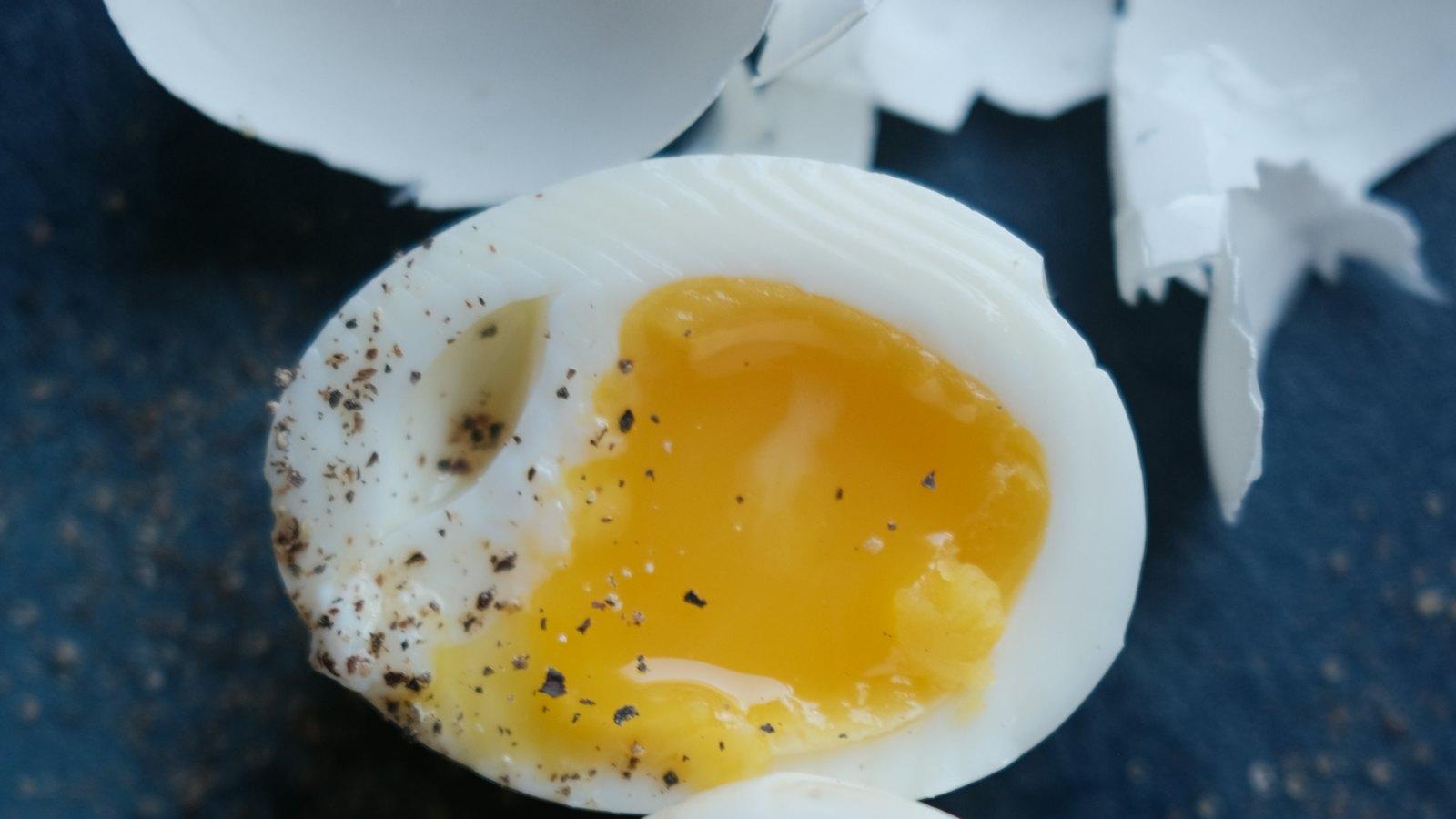
Everything you might want lies between them. A soft-boiled egg uses the gap: the white is set, the yolk still liquid. A hard-boiled egg has crossed both thresholds, and an overcooked one has stayed past them long enough for sulphur from the white to combine with iron from the yolk — hence the green-grey ring.
The times
From boiling water, for a medium egg straight from the fridge:
Soft: five minutes. White just set, yolk running. Medium: seven minutes. Yolk creamy but no longer liquid. Hard: nine to ten minutes. Longer achieves nothing but the grey ring.
Two things shift this more than anything else. Size: a large egg needs half a minute to a minute longer than a medium one. And starting temperature: an egg at room temperature is done about a minute sooner.
If you want precision, do not measure the time — use eggs of the same size at the same temperature. It is the same thought as with asparagus, where spears of equal thickness help more than any clock: what makes asparagus season so short.
Why fresh eggs are harder to peel
A quirk many people mistake for a fault. In a fresh egg the pH of the white is low and it clings more tightly to the inner shell membrane. Over days the pH rises and the egg releases more easily.
So for hard-boiled eggs, week-old eggs are the better ones. For everything else the opposite applies.
The fried egg
The most frequently mistreated of them. Fried too hot, the edge goes brown and hard before the white on top has set, and the yolk is either raw or cooked through.
Medium heat, butter, and a lid for the last thirty seconds: the steam sets the white on top without cooking the yolk.
Scrambled eggs
Heat is the usual mistake. Eggs over high heat turn rubbery and give up water; what is left is dry and swimming at the same time.
What works is low heat and patience: in butter, moved constantly, and off the heat before they look done. Residual heat finishes them — the same principle as with fish, described in fish in a country with no coast.
Salt at the end. Salt at the start draws water out of the eggs, and it ends up in the pan rather than in the egg.
Milk is unnecessary. For creaminess, beat in a knob of cold butter at the finish — the same technique that binds a risotto, as described in risotto does not stir itself.
How to tell a good egg
Not by the colour of the shell — that depends solely on the breed of hen and says nothing about quality or flavour.
Cracked open, more is visible. A fresh egg has a yolk that stands high and domed, and a white in two recognisable layers: a thicker one around the yolk and a thinner one outside it. In an old egg the yolk flattens and the white spreads.
The float test works too: a fresh egg lies flat on the bottom in cold water. Over days air passes through the shell, the air cell grows, and the egg stands up. If it stands upright or floats, it does not belong in a pan.
Every egg in Austria is stamped. The first digit is the husbandry: 0 organic, 1 free range, 2 barn.
The poached egg
The hardest of them, and it needs only two things: a very fresh egg and water that trembles rather than boils. Vinegar in the water helps a little but matters less than the freshness — an old egg has thin white that streams away in the water, and no trick fixes that.
Book a table and say how you want it.