"Everything in its place" is the literal translation, and it describes a time rather than a state: by half past five a kitchen is prepared, or the evening goes wrong.
Why more depends on this than on friendliness is in our guide to service.
It is a time, not a state
Half past five is not a target but a deadline. What is not ready by then will not be ready during service either.
What gets prepared
Everything that takes time and loses nothing by waiting. Stocks and sauces are finished in the morning. Braises have been standing since yesterday and are better for it — why that is so is in why a goulash needs time.
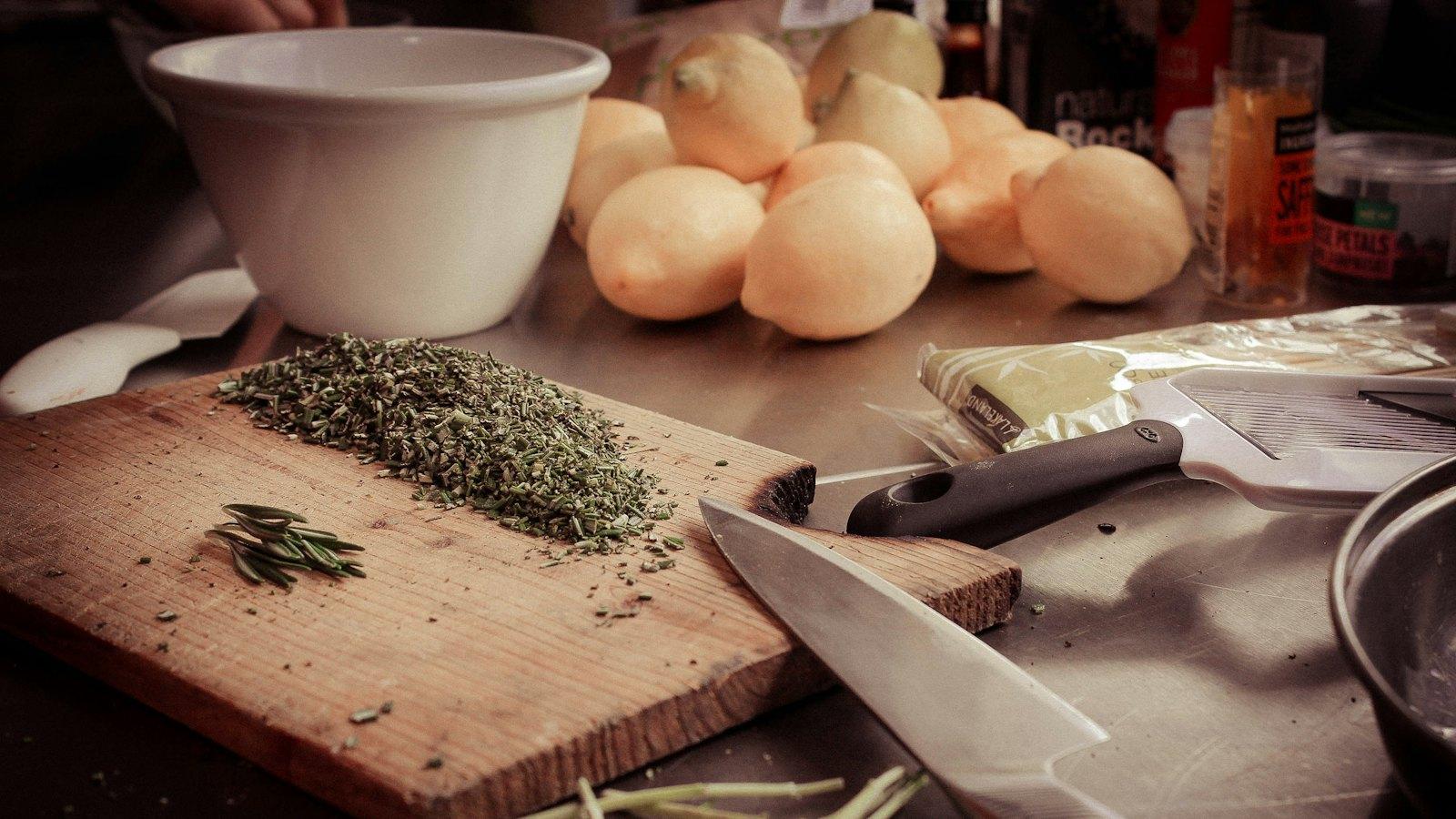
Vegetables are trimmed and cut. Dressings are mixed. Bread is sliced, herbs washed, lemons pressed. Pickles have been ready for weeks anyway.
The result is a kitchen where every movement during service reaches into a container that sits in a known place. Nobody searches; nobody stops to chop an onion.
The dividing line is a decision
What gets prepared and what does not is not a question of effort but of what loses by standing.
What must not be prepared
The shorter and more important list. Crumbing happens when the order comes in, because otherwise the coating goes damp — set out in what actually matters in a Wiener Schnitzel.
Risotto is cooked to order because it carries on cooking. Fish is fried when it is ordered. Salad is dressed at the last moment or it collapses. And citrus juice for the bar is pressed the same day, as citrus and acidity behind the bar describes.
It is precisely this dividing line that decides how long a menu can be. The more dishes fall into the second category, the shorter it has to be.
The stations are an order, not a place
A kitchen station is not only a position but a fixed arrangement: salt on the left, oil on the right, tongs where they were yesterday. It sounds pedantic and it is why nobody has to think about where anything is at eight in the evening.
Searching during a busy service does not cost seconds, it costs attention — and attention is what is missing at the pass afterwards.
So after every service things are put back, cleaned and restocked before anyone goes home. Tomorrow's mise en place begins at the end of tonight, not in the morning.
What is left over
At the end of an evening something always remains: a stock started, vegetables cut, half a pan of sauce. What is still good tomorrow and what is not is not a matter of judgement but a list — labelled, dated, chilled.
Much of it becomes something else. Vegetable trimmings become stock, stale bread becomes crumbs, herb stalks become seasoning. The thinking behind that is in two kitchens, one shopping list.
The room has a mise en place too
The part a guest sees without noticing. Tables are laid, glasses polished, cutlery sorted. Candles are lit before the first guest arrives, not after.
The stations are stocked: napkins, cutlery, coasters, water jugs — all where service can pick them up in passing rather than crossing the room. Every unnecessary trip costs minutes on a busy evening, and minutes are what eventually reaches the guest.
Polishing happens over steam, for a reason set out in the glass and the temperature.
The briefing before service
Five minutes on which everything hangs: what is new today, what has run out, how many bookings there are, whether there is an occasion, an allergy, a large party.
A service team that knows a table of ten arrives at eight plans the evening differently — what that means for the kitchen is in planning a large table.
The briefing is short
Five minutes, standing, with everybody. It does not run longer, because afterwards there is work to do.
Why it becomes visible
As a guest you only notice mise en place negatively. A jug of water that takes ten minutes, bread that has to be cut first, a waiter who goes back three times — all of those are preparation failures rather than failures of courtesy.
Conversely, a well-prepared evening looks effortless, and that is the entire intention.
Book a table — everything is ready by half past five.